
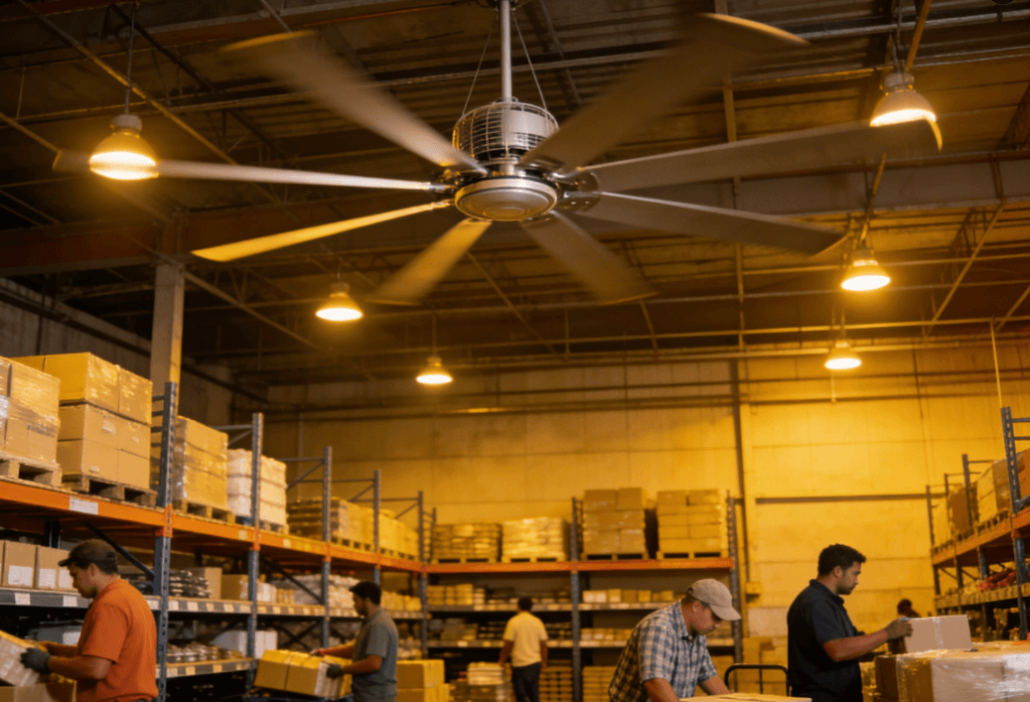
Why Heavy-Duty Industrial Fans Are the Cornerstone of Factory Air Management?
In the heart of every bustling warehouse, the precision of a assembly line, and the vastness of a distribution center, one invisible element dictates success: the quality of the air. Stagnant air leads to fatigued workers, malfunctioning equipment, and hidden operational costs.
While complex HVAC systems have their place, the true backbone of effective industrial ventilation remains the heavy-duty industrial fan. As a manufacturer of these essential tools, we understand that getting the air right doesn’t require over-engineering—it requires engineering that lasts. This guide cuts through the noise to explain why a purpose-built axial or centrifugal fan from a dedicated factory is the smartest investment you can make for your facility’s health, safety, and bottom line.
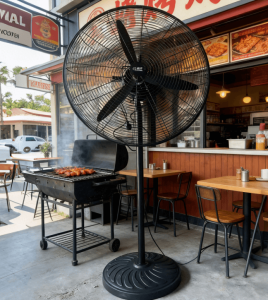
The Manufacturing Advantage: Built for the Floor, Not the Store Shelf
There is a distinct difference between a light-duty unit labeled “industrial” and a fan actually built in an industrial factory. When you source directly from a manufacturer, you aren’t just buying a motor and blades; you are buying a machine engineered for the specific stresses of a 24/7 environment.
Standard industrial fans solve three universal problems better than any other technology:
1. Thermal Stratification: Breaking up the layers of scalding hot air trapped at the roofline.
2.Air Quality: Diluting airborne dust, weld smoke, or exhaust fumes.
3. Moisture Control: Drying damp floors and preventing corrosion.
For these challenges, our philosophy is simple: provide maximum airflow with maximum durability, ensuring our fans remain the most cost-effective tool in your facility management arsenal.
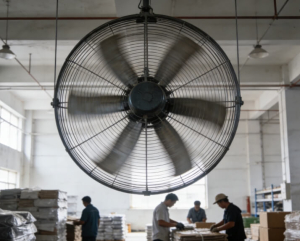
Selecting Your Solution: Axial vs. Centrifugal Airflow
Before selecting a model, you must understand the physics of your space. Are you moving air through open space, or are you pushing it through a maze of ducts and filters?
Axial Fans: The High-Volume Specialists
True to their name, axial fans move air along the axis of the motor. Think of them as the “propellers” of the industrial world.
– Best Applications: Wall-mounted exhaust, portable spot cooling, warehouse ceiling circulation, and general air exchange.
– The Factory Advantage: Our axial fans are designed with precision-balanced blades to deliver maximum Cubic Feet per Minute (CFM) with minimal vibration, ensuring long motor life even in continuous operation.
– Ideal For: Anywhere you need to feel a breeze or exchange a massive volume of air quickly.
Centrifugal Fans: The High-Pressure Generators
These fans, often called “blowers” or “squirrel cage” fans, draw air into the center of a wheel and expel it at a 90-degree angle using centrifugal force.
– Best Applications: Moving air through long runs of ductwork, pushing through dirty filters on dust collectors, supplying air to ovens, or creating air curtains.
– The Factory Advantage: We build our impellers and housings with tight tolerances to capture all that pressure. A poorly built centrifugal fan leaks air; ours is built to direct every bit of energy to the work site.
– Ideal For: Systems that require resistance (static pressure) to move air where it needs to go.
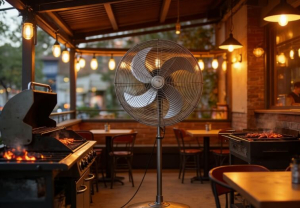
The Manufacturer’s Rule: Open space? Choose our Axial line. Ducted or filtered? Choose our Centrifugal line.
Key Features of Factory-Grade Construction
As the builders of these fans, we control the quality from raw steel to final assembly. Here is what sets our “standard” fans apart from commodity imports:
– All-Welded Steel Housings: We don’t rely on pop-rivets or light-gauge stampings. Our fans feature heavy-gauge steel with reinforced, continuous welds that prevent warping and structural fatigue.
– Totally Enclosed Fan-Cooled (TEFC) Motors: We pair our fans with industrial TEFC ball-bearing motors. These are designed to reject dust, moisture, and debris, ensuring the motor runs cool even in hot environments.
– Strict Adherence to Safety Standards: Guards are built with mesh tight enough to meet OSHA requirements, and portable bases are engineered with a wide stance to prevent tipping.
– Balanced for Vibration-Free Life: Each blade and wheel is dynamically balanced at the factory. Less vibration means quieter operation and exponentially longer bearing and motor life.
– Corrosion-Resistant Finishes: A simple paint job isn’t enough. We apply durable powder coatings or industrial enamels that stand up to humidity and light chemical exposure.
Matching the Fan to Your Factory Floor
– The Loading Dock: Use a high-velocity centrifugal blower mounted overhead. It acts as an air barrier, keeping conditioned air in and bugs/exhaust out when the big doors go up.
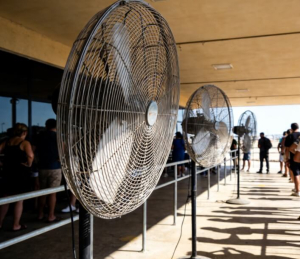
– The Assembly Line: Personnel cooling is best served by portable pedestal axial fans. They can be moved to target specific stations as workflows change, keeping assemblers cool without wasting air on empty aisles.
– The Paint Booth or Welding Station: A non-sparking axial or centrifugal fan (with the proper motor rating) is essential for exhausting flammable fumes or fine particulates safely.
– The Warehouse Aisles: Large-diameter, low-speed axial fans mounted to the structure are the most efficient way to de-stratify heat and keep inventory at a stable temperature.
The Clear-Cut Benefits of Buying Smart
When you install a fan built in our factory, you are installing long-term value:
- Lower Total Cost of Ownership: We use thicker steel and better motors so you don’t have to replace fans every 2-3 years. Our fans are built to be serviced, not scrapped.
- Energy Arbitrage: By using high-volume, low-speed axial fans in summer, you can raise your thermostat setpoint by several degrees without impacting comfort, leading to massive HVAC savings.
- Regulatory Compliance: Proper ventilation is often required to meet OSHA standards for indoor air quality and heat stress prevention.
- Asset Protection: Consistent airflow reduces humidity pockets that cause rust on metal stock and mold on dry goods.
How to Select the Right Size for Your Facility
Don’t guess. Use the standard Air Change method to determine your CFM needs.
1.Calculate Cubic Feet: Measure Length x Width x Average Ceiling Height.
2.Determine Air Changes per Hour (ACH):
– Minimum Ventilation: 3-4 ACH
– General Factory/Warehouse: 5-8 ACH
– Hot Environments/Heavy Exhaust: 8-12 ACH
3.Apply the Formula:
(Example: A 20,000 sq ft warehouse with 25ft ceilings has a volume of 500,000 cu/ft. For 6 ACH: (500,000 x 6) / 60 = 50,000 CFM required. This could be achieved by a strategic placement of multiple 20,000 CFM axial fans.)
Conclusion: Power, Simplicity, and the Promise of Quality
You don’t need a complicated solution to solve a simple problem. You need reliable equipment that moves air efficiently and survives the rigors of the industrial environment. By choosing fans manufactured with pride and precision, you are investing in the comfort of your people and the efficiency of your operations.
Let us put our manufacturing expertise to work for you. Our standard industrial fans are anything but standard—they are the result of decades of engineering focused on one goal: delivering the right air, to the right place, for the longest time possible.
Ready to Experience the Factory Difference?
Browse our catalog of heavy-duty axial and centrifugal fans. Whether you need a single portable unit to cool a hot spot or a fleet of fans for a new facility, our team is ready to help you select the perfect, cost-effective solution. [Contact Our Sales Engineers Today] for a quote or sizing consultation.


Leave a Reply
Want to join the discussion?Feel free to contribute!