
Mastering Industrial Air: How to Match the Right Fan to Your Specific Environmental Challenge
In the industrial world, air is not just air. It can be a silent productivity killer, a safety hazard, or a costly inefficiency. Whether you are battling stagnant heat trapped in a 30-foot ceiling, clearing welding fumes from a fabrication bay, or drying a wash-down floor to prevent slips, the common denominator is the need for a robust, purpose-built air-moving solution.
As a dedicated manufacturer of industrial ventilation equipment, we know that a “one-size-fits-all” approach fails in the diverse landscape of factories and warehouses. The key to unlocking a comfortable, safe, and efficient workspace lies in diagnosing the specific problem and deploying the right tool for the job. This guide moves beyond the basics to help you match our heavy-duty fans to your most persistent environmental challenges.
The Four Pillars of Industrial Air Management
Every industrial ventilation problem generally falls into one of four categories. By identifying which pillar your facility struggles with, you are halfway to selecting the perfect fan.
- Heat Destratification: Breaking up layers of hot air at the ceiling.
- General Ventilation: Exchanging stale, oxygen-depleted air for fresh outside air.
- Spot Cooling: Creating a breeze to cool a worker or a specific process.
- Contaminant Control: Diluting or capturing fumes, dust, and humidity.
Let’s explore how our axial and centrifugal fan lines are engineered to tackle each one.
Challenge #1: The Heat Island (Thermal Stratification)
The Problem: In any facility with high ceilings, physics works against you. Hot air rises, creating a desert of sweltering heat at the roof level while the floor where people work remains cold in winter or merely stuffy in summer. This “heat island” forces your HVAC to overwork in winter and creates oppressive conditions in summer .
The Wrong Solution: A small, high-speed pedestal fan on the floor. It does nothing to break up the stratified layers and merely shuffles hot air around at ground level.
The Factory Solution: High-Volume, Low-Speed (HVLS) Ceiling Fans
– How it works: These large-diameter fans (ours range from 8 to 24 feet) move a massive column of air gently down to the floor, pushing warm air from the ceiling outwards and downwards. This process, known as destratification, mixes the air completely .
– The Benefit:
– Winter Savings: By pushing trapped ceiling heat back to the floor, you can reduce heating costs by as much as 20-30%.
– Summer Comfort: The gentle breeze creates a wind chill effect, making workers feel up to 10°F cooler without lowering the thermostat .
– Even Temps: Eliminates hot and cold spots throughout the facility.
Challenge #2: The Stale Air Lock (General Air Exchange)
The Problem: Warehouses and shops can feel “stuffy” or develop musty odors. This indicates a lack of fresh outside air and a buildup of CO2, light dust, or airborne vapors. You need to physically remove the bad air and pull in fresh air.
The Wrong Solution: Relying solely on leaky dock doors for “natural” ventilation provides no control and no consistent airflow.
The Factory Solution: Heavy-Duty Axial Wall or Roof Exhaust Fans
– How it works: Axial fans are the workhorses of air exchange. Our wall-mounted versions are designed to be installed in the wall or roof, acting as powerful exhaust units that pull air out of the building, creating negative pressure that draws fresh air in through vents or open doors .
– The Benefit:
– High Volume: These fans excel at moving the high volumes of air (CFM) required to change the air in a massive space quickly.
– Cost-Effective: They provide the highest CFM per dollar and per energy unit of any fan type.
– Versatility: Ideal for warehouses, loading docks, and distribution centers where general air quality is the primary concern .
Challenge #3: The Hot Zone (Spot Cooling & Personnel Relief)
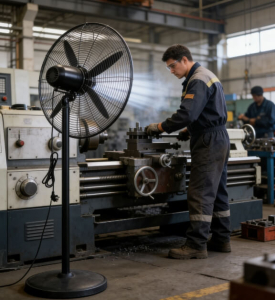
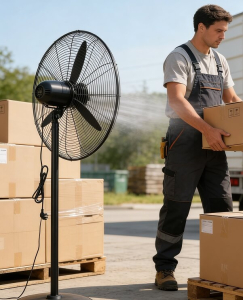
The Problem: You can’t always condition the entire space. Perhaps you have a loading dock worker unloading trailers in the summer sun, or a technician stationed near hot machinery. These localized “hot zones” require direct, targeted airflow to keep workers safe and productive .
The Wrong Solution: Over-cooling the entire warehouse, which is prohibitively expensive.
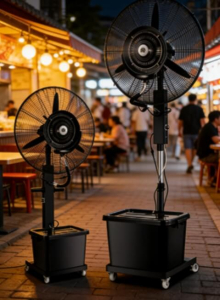
The Factory Solution: Portable Barrel Fans & Wall-Mount Air Circulators
– How it works: This is where maneuverability meets power. Our portable “drum” or “barrel” fans (axial design) can be wheeled directly to the point of need. For fixed locations, our articulating wall-mount fans can be aimed precisely at a workstation .
– The Benefit:
– Worker Safety: Direct airflow is the most effective engineering control for preventing heat stress in high-activity zones, a key component of OSHA guidelines .
– Targeted Efficiency: You only move air where it’s needed, rather than wasting energy on empty square footage.
– Flexibility: Portable units can be repositioned as workflows change throughout the day.
Challenge #4: The Contaminant Cloud (Fumes, Dust & Moisture)
The Problem: Welding smoke, chemical fumes from a cleaning station, or heavy dust from a packaging line can accumulate in a specific area, creating health hazards and visibility issues. These contaminants need to be captured at the source or forced through filtration .
The Wrong Solution: A standard axial fan blowing through the contaminant cloud, which merely spreads it around the shop.
The Factory Solution: High-Pressure Centrifugal Blowers
– How it works: Unlike axial fans, centrifugal fans (or blowers) generate high static pressure. This allows them to suck air through a capture hood and push it through long runs of ductwork and filters .
– The Benefit:
– Ductability: The high pressure is essential for overcoming the resistance of ducts. This allows you to vent fumes directly outside or push them through a filtration system .
– Source Capture: When paired with ducting, a centrifugal fan can be placed at a distance while a capture arm pulls contaminants directly from the weld or chemical bath .
– Drying Power: The focused, high-pressure output is also perfect for drying floors or equipment after washdowns.
The Manufacturer’s Advantage: Built for the Challenge
When you source your ventilation solution from our factory, you are not just buying a fan; you are buying a guarantee that the equipment is built to handle the specific stress of your application.
– For High-Heat Zones: Our motors are equipped with thermal overload protection and are rated for continuous duty in high ambient temperatures.
– For Dusty Environments: We offer Totally Enclosed Fan-Cooled (TEFC) motors that prevent dust ingestion, ensuring longevity .
– For Corrosive or Hazardous Areas: We can provide models with spark-resistant blades, epoxy coatings, or explosion-proof certifications to meet NFPA and OSHA standards .
– For Structural Integrity: Our fan housings and mounts are fabricated from heavy-gauge steel, welded for strength, ensuring they withstand vibration and stay safely mounted for decades.
A Simple Framework for Diagnosing Your Needs
Use this quick guide the next time a problem arises on your floor:
- Is the entire facility hot from the ceiling down?
– Solution: Look at Large Diameter HVLS Ceiling Fans for destratification.
- Does the air feel “stale” or smell bad everywhere?
– Solution: Look at High-Volume Axial Wall/Roof Fans for general air exchange.
- Is there one specific station where workers are suffering from heat or fumes?
– Solution: Look at Portable Barrel Fans or Articulating Wall-Mount Fans for spot cooling or Centrifugal Blowers with duct arms for fume extraction.
- Do you need to push air through pipes or filters?
– Solution: Look at Centrifugal Blowers for their high static pressure capabilities.
Conclusion: Engineering Air, Solving Problems
Your facility is unique, and its challenges are specific. By moving beyond generic ventilation ideas and adopting a targeted approach, you can transform your workspace. Whether you need to reclaim wasted heat from the ceiling, clear a loading dock of diesel fumes, or give an assembly line worker relief from the summer sun, we have an industrial fan engineered specifically for that task.
Don’t let another season of discomfort and inefficiency pass you by. Let’s diagnose your problem and build the perfect solution.
Ready to Solve Your Airflow Challenges?
Browse our extensive catalog of axial, centrifugal, and HVLS fans. Our team of factory experts understands the demands of industrial environments. [Contact Us Today] for a personalized consultation and a no-obligation recommendation on the exact fan model and size your facility needs to stay productive, safe, and comfortable year-round.


Leave a Reply
Want to join the discussion?Feel free to contribute!