

Industrial Fans: The Essential Guide to Basic, Reliable & Cost-Effective Ventilation Solutions
Every industrial, commercial, or warehouse space needs one thing to stay safe, comfortable, and productive: consistent, reliable airflow. For the vast majority of these spaces, the answer isn’t found in exotic, expensive, or over-engineered systems. It’s found in a high-quality, well-built industrial fan. This guide focuses on the core value of standard axial and centrifugal fans—the workhorses of industrial ventilation. We’ll show you why these fundamental tools remain indispensable, how to select the right one for common applications, and how they deliver an outstanding return on investment through simplicity, durability, and performance.

Why Basic Industrial Fans Are Still Your Best First Choice?
Before considering complex systems, it’s important to recognize the power and efficiency of well-designed standard fans for solving common environmental challenges:
Heat Buildup in Warehouses & Shops: Stagnant hot air under ceilings lowers comfort and raises cooling costs.
Poor Air Circulation in Large Spaces: “Dead zones” with no air movement feel stuffy, trap odors, and allow humidity to rise.
General Dust & Fume Dispersal: Light to moderate dust from production or fumes from occasional welding need to be moved away from workers.
Drying Floors & Surfaces: After cleaning or due to minor spills, speeding up dry time is crucial for safety.
Personnel Cooling in Specific Areas: Providing direct comfort for workers on assembly lines, loading docks, or in kitchens.
For these everyday issues, a standard industrial fan provides a direct, powerful, and cost-effective solution without unnecessary complexity.
Understanding Your Two Main Workhorses: Axial vs. Centrifugal
Choosing between these two primary types is the most important decision for most buyers.
Axial Fans: The Masters of High-Volume, Low-Pressure Air Movement
How They Work: Think of an airplane propeller. They draw air in parallel to the shaft and blow it straight out the other side in a high-volume column.
Best For:
General Ventilation: Mounting in walls, windows, or ceilings to exchange air in a workshop or warehouse.
Spot Cooling: Placing a large portable barrel fan to cool workers or equipment.
Exhausting Large Spaces: Removing hot air, light smoke, or odors from a building.
Key Advantage: They move a large volume of air (high CFM) very efficiently when there’s little resistance (low static pressure).
Centrifugal Fans: The Power for Pressure & Ducting
How They Work: Air enters the fan’s center, is accelerated by a spinning impeller, and is expelled perpendicularly to the shaft at a higher pressure.
Best For:
Ducted Systems: Pushing or pulling air through ventilation ducts, pipes, or across filters.
Overcoming Resistance: Applications where air must be forced through something, like a dryer, an oven, or a dust collection filter.
More Focused, Higher-Pressure Airflow: Where you need to direct air with more “force” over a distance.
Key Advantage: They create higher static pressure, making them ideal for systems with ductwork or filtration.
Simple Rule of Thumb: Need to move lots of air in an open space? Choose Axial. Need to move air through something? Choose Centrifugal.
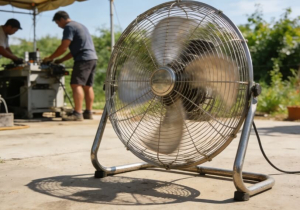
Key Features to Look for in a Quality Standard Fan
Not all “industrial” fans are built for true industrial duty. Here’s what separates reliable equipment from disposable hardware:
Robust Construction: Heavy-gauge steel housings and guards, securely welded or riveted—not thin, flimsy metal.
Industrial-Grade Motor: Look for a durable, permanently lubricated ball-bearing motor with a proper thermal overload protector. Horsepower (HP) should be honest and adequate.
Safety-First Design: Fully guarded openings with mesh small enough to prevent finger contact. A stable, tip-resistant base for portable models.
Proper Electrical Rating: UL/CUL listed components for safety and insurance compliance.
Practical Versatility: Options for easy mounting (wall, ceiling, pole) or robust portability (heavy-duty wheels, handles).
Matching the Fan to Your Common Application
Large Warehouse Ventilation: Multiple large-diameter axial fans (e.g., 24″, 36″, 48″) mounted high on columns or walls to create cross-ventilation.
Workshop General Air Exchange: A combination of wall-mounted exhaust fans and pedestal fans for spot cooling at workbenches.
Loading Dock & Doorway Air Curtains: Heavy-duty centrifugal blowers mounted above doors to create an air barrier, keeping out insects, dust, and conditioned air in.
Drying Floors After Washdown: High-velocity portable axial (“barrel”) fans set up to create a sweeping airflow across wet surfaces overnight.
Office or Breakroom Supplement: Quieter, lower-speed axial fans to assist HVAC and improve comfort in semi-industrial areas.

The Clear-Cut Benefits: Why This Simple Solution Works
Investing in proper standard industrial fans provides immediate and ongoing returns:
- Immediate Cost Savings: Drastically lower upfront and installation costs compared to complex HVAC upgrades.
- Reduced Energy Costs: Improving air circulation can allow you to set thermostats higher in summer, reducing AC costs. Using fans alone is far cheaper than cooling.
- Enhanced Safety & Compliance: Mitigates heat stress, improves visibility by clearing light fumes, and dries floors to prevent slips—all supporting OSHA guidelines.
- Boosted Productivity & Morale: A cooler, fresher workspace keeps employees more alert, comfortable, and focused.
- Proven Reliability & Easy Maintenance: With fewer complex parts, a well-built fan offers years of service with simple cleaning and occasional bearing checks.
How to Select the Right Size & Power
A common mistake is buying an undersized fan. A simple approach:
- Calculate Room Volume: Length (ft) x Width (ft) x Average Height (ft).
- Determine Required Air Changes per Hour (ACH): For general ventilation, aim for 4-6 ACH. For warmer spaces or light fumes, 6-10 ACH.
- Calculate Required CFM: (Room Volume x ACH) / 60 minutes.
Example: A 50′ x 100′ workshop with a 20′ ceiling needs 6 ACH.
Volume = 50x100x20 = 100,000 cubic feet.
CFM Needed = (100,000 x 6) / 60 = 10,000 CFM.
This could be met by two 5,000 CFM axial fans or several smaller units.

Conclusion: Power, Simplicity, Value
In a world of increasingly complex solutions, the industrial fan stands out for its elegant simplicity and profound effectiveness. It solves fundamental problems of air, heat, and comfort directly and affordably. By choosing a correctly sized, well-constructed standard fan for your space, you are investing in a tool that pays for itself through improved working conditions, lower operational costs, and reliable performance year after year.
You don’t always need a high-tech solution. Often, you just need the right air in the right place.
Ready to Find Your Simple, Effective Ventilation Solution?
Browse our extensive catalog of reliable, value-priced industrial axial and centrifugal fans. Use our easy selection guides or contact our product specialists for a free, no-obligation recommendation on the best fan model and size for your specific space and needs. Get the air moving today.


Leave a Reply
Want to join the discussion?Feel free to contribute!