

How to Choose the Perfect Industrial Fan for Maximum Airflow_ A Buyer’s Guide
Selection of an industrial fan is one of the most important decisions for every facility that relies on appropriate ventilation, temperature regulation, and air movement. Regardless of the nature of your work place, the kind of industrial fan placed can have a significant effect on the comfort of the workers, their productivity and the overall efficiency of their operations. In this regard, it is easy to get confused about where to start, knowing there are so many models, airflow capacities, and design options.
This article will assist you in knowing what to expect when choosing the ideal industrial fan that offers the maximum airflow performance, high durability, and energy efficiency. Whether it is a blade size and types of motors or an installation style and related maintenance issues, this guide will have all what you need to make a wise choice.
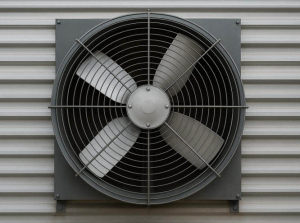
Why Choosing the Right Industrial Fan Matters
Industrial fans are not merely the cooling devices, but an essential component of workplace safety and air quality maintenance. Adequate choice of a fan provides the ability to maintain the temperature within the house, eliminate hot places, dampness, and prevent the formation of air pollutants within the workspace. Adequate ventilation is also associated with better health, less fatigue, and increased productivity of the employees.
Poor ventilation can lead to:
- Heat stress among workers
- Dust and fume accumulation
- Equipment overheating
- Uncomfortable or unsafe working conditions
When selecting a fan that is made to fit your particular setting, you are guaranteed of constant supply of fresh air and safety of maximum airflow efficiency.
1.Understand Your Airflow Requirements
You have to know how much air the workspace requires before purchasing a fan. Various industries have several levels of ventilation depending on the amount of heat produced, the nature of the machinery and the building layout.
Key considerations:
• Facility Size and Ceiling Height
Greater spaces require fans that have a greater CFM (cubic feet per minute) rating. HVLS (High-Volume, Low-Speed) fans might be necessary when dealing with high ceilings to cover a large area of the air.
• Type of Operations
Areas that involve welding, printing, chemical processing or machining produce smoke, fumes or heat, as well as this need more direct and powerful airflow.
• Ventilation Hotspots
Determine heat or dust-prone areas and select fans that are able to act on those areas.
Knowing these factors, you would know the best size of the fan, type of blade and speed of the fan to get high airflow performance.
Understanding these factors helps you determine the ideal fan size, blade type, and speed needed for high airflow performance.
2. Compare Different Types of Industrial Fans
There are different types of industrial fans, which are meant to serve various patterns of airflow and requirements of installation. The kind of type used really counts in performance.
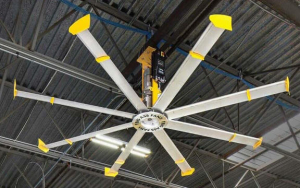
• HVLS Fans (High-Volume, Low-Speed)
These enormous ceiling mounted fans circulate huge masses of air at lower speeds. They can be used in warehouses, barns and in large industrial halls.
• Portable Industrial Fans
Appropriate when flexible and on the go ventilation is required. They can be transferred to other stations based on the work demand.
• Inline Duct Fans
Applied in tunnel-like or ducted ventilation, commonly in manufacturing or chemical processing plants.
• Exhaust Fans
These assist in the elimination of polluted air, heat and fumes in the confined spaces.
Identifying the strengths of both types of fans would mean that you would select a model that suits your airflow requirements and design.
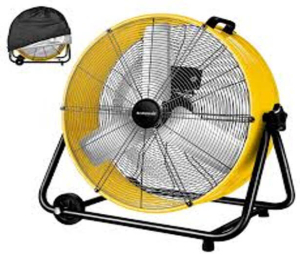
3. Check the Fan’s Airflow Capacity (CFM Rating)
CFM rating reveals the amount of air that a fan is capable of moving in a minute, and so it is one of the most significant specifications in an industrial environment. Increased CFM implies increased ventilation and powerful airflow. As a general rule, small workshops usually need 3,000-6,000 CFM, medium warehouses usually need 10,000-20,000 CFM, and large industrial areas usually need over 20,000 CFM. HVLS fans are capable of providing extremely high airflow, as much as 100,000 CFM in some cases, and it depends on the diameter. In choosing a fan, you need to match the CFM rating to both size and use of your working space as over-sized will waste energy and undersize will not give enough airflow.
4. Material and Build Quality
The surrounding conditions that the industrial fans have to endure include heat, dust, chemicals and constant use.
Choose fans built with:
- Powder-coated or stainless-steel bodies
- Corrosion-resistant blades
- Heavy-duty motors rated for industrial use
- Reinforced mounts that prevent vibration
Durability is also paramount since the industrial fans will be on 24/7. A superior fan has a long life and low maintenance expenses.
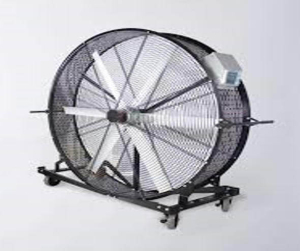
5. Energy Efficiency and Motor Type
As the cost of energy increases, it is important that an energy efficient industrial fan is selected. The efficiency is very dependent on the kind of motor.
Common industrial motor types:
- EC Motors (Electronically Commutated): Very quiet and efficient.
- AC Motors: Heavy and powerful and suited to heavy work.
- DC Motors: Great for adjustable speed and energy savings
The motors which are becoming popular are the EC motors since they provide high airflow performance at a reduced power consumption.
You may get familiar with industrial fan energy standards using such resources as efficiency taught by the U.S. Department of Energy’s efficiency
6.Noise Levels
Another factor is noise which cannot be ignored particularly in close factories or workshops. Industrial fans that are high-performance are made to move air effectively and reduce noise.
Tips on the selection of low-noise fans:
- Find aerodynamic-shaped blades.
- select fans with vibration mounts.
- HVLS fans are clean with large airflow.
- Reduced noise levels also lead to a better work environment.
7. Installation and Placement Considerations
Even the best industrial fan won’t perform properly if installed incorrectly. Proper placement ensures airflow reaches the intended areas.
Placement tips:
- Ceiling fans should be installed at the recommended clearance height
- Wall-mounted fans should target heat zones or workstations
- Portable fans should be positioned at angles that enhance cross-ventilation
- Exhaust fans must be installed near the primary source of fumes
A professional installation guarantees optimal airflow distribution and safety.
8. Maintenance Needs
Regular maintenance extends the lifespan of industrial fans and ensures continuous performance.
Maintenance tasks include:
- Cleaning blades and grill covers
- Checking for vibrations
- Lubricating motor parts
Selecting fans with easy-access components makes maintenance quicker and more cost-efficient.
Conclusion:
The choice of the ideal industrial fan has a direct influence on comfort, safety, and productivity at the workplace. You can make sure that you invest in a fan that will give you exceptional performance by assessing the requirements of the airflow, the type of fan you want, considering such critical factors as CFM, motor efficiency, quality of the build, and the installation.
Industrial fans are not simply cooling solutions: they are necessary ventilation of the factory which is helpful in terms of the human conditions, efficiency of working and managing the environment. Your facility will be able to have cleaner air, higher quality airflow and reliability with the right fan.


Leave a Reply
Want to join the discussion?Feel free to contribute!