

A Guide to Choosing the Perfect Industrial Fan for Maximum Airflow
A Guide to Choosing the Perfect Industrial Fan for Maximum Airflow
Ventilation efficiency is important in industrial environments today, both in terms of comfort and safety as well as efficiency. An appropriate industrial fan can improve the quality of air, temperature, and the productivity level significantly in a factory, a warehouse, or an agribusiness.
The choice of equipment, whether it is an industrial blower, a mist fan, or a high-volume air circulator, however, is an element of being knowledgeable about the forces of airflow and what your facility requires.
The following guide is a practical and easy-to-understand guide that will assist you in making the right decision in terms of selecting the ideal industrial fan that will perform optimally and last long.
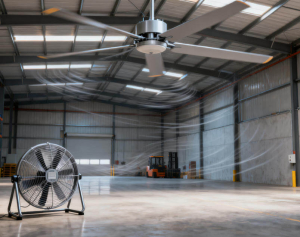
Understanding Why Airflow Matters in Industrial Environments
Airflow directly influences worker safety, efficiency of machinery, and costs of operation. Inadequate air circulation will result in stagnant areas, overheated machines, and unfavorable working conditions. This is why airflow management is an important component of any industrial system:
- Stops heat accumulation: Industrial work stations and large workforces predetermine the accumulation of heat; the normal flow of the air provides the equilibrium of temperature.
- Improves the atmosphere in the air: Removes dust, fumes, and gases to enjoy a cleaner work environment.
- Checks humidity: Measures the moisture and eradicates corrosion or damage of the products.
- Saves energy: Makes the HVAC systems more efficient and minimizes the power costs.
- Meets safety requirements: Ensures that it is well-ventilated in accordance with the regulations.
Exploring the Main Types of Industrial Air-Moving Equipment
Airflow systems in different spaces are different. This knowledge of the most important industrial air-moving equipment will assist you in making the right decision.
1. High Volume Air Movement Industrial Fan, Open Spaces.
An industrial fan is one that is created to circulate a considerable amount of air under comparatively lower pressure, so it can be suggested as quite suitable in the open or semi-open space, like a warehouse, workshop, or assembly floor.
Typical forms of industrial fans are:
- Axial fans: They are fans that move air straight in a straight line, and they are ideal for general ventilation and cooling.
- HVLS (High Volume, Low Speed) fans: These are large ceiling-mounted fans with a high air volume that circulate large volumes of air in a low noise manner.
- Pedestal fan and wall-mounted fans: Localized cooling with flexible and portable solutions.
The most energy-efficient option for keeping the air moving steadily within large spaces is frequently industrial fans.
2. Industrial Blower -High-Pressure Airflow Ducted or Confined.
An industrial blower has more air pressure than a typical fan and is employed where air has to traverse ducts, filters, or other systems that are resistance-based.
The industrial blowers are used in applications:
- Air conditioning in underground areas or rooms.
- Supply of air to furnaces, kilns, or combustion.
- Removal of fumes, dust, or moisture using ductwork.
Blowers are constructed to withstand greater amounts of static pressure and provide a constant flow of air where the use of fans may be inadequate.
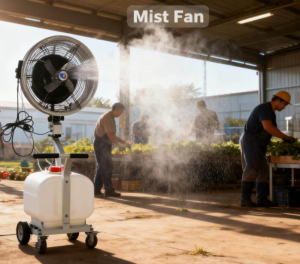
3. Mist Fan -Airflow and Evaporative Cooling.
A mist fan provides a cooling effect in addition to airflow to the air by spraying fine mist. When the mist evaporates, the temperature of the surroundings is cooled by the natural evaporative cooling.
Ideal use cases for mist fans:
- Workplaces in the open or semi-open places.
- Warm and low-humidity industrial conditions.
- Portable cooling is required in agricultural areas, sports areas, or event areas.
Mist fans particularly perform well in arid climates, and they do not require the full air conditioning system; and cool immediately.
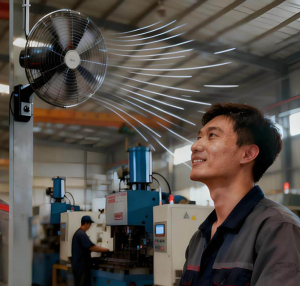
Key Factors to Consider When Choosing an Industrial Fan or Blower
In choosing the appropriate industrial fan or industrial blower, a number of factors will define how effective and efficient your system is going to be.
1. Airflow Capacity (CFM) -The Amount of Air You Have to Move.
The Fan or blower capacity is in Cubic Feet per Minute (CFM). Dividing the total air intake (ml of air)/your body mass (kg of body mass):
CFM= Room Volume (ft 3 )1/60Air Changes per Hour (ACH)CFM= Room Volume(ft3)Air Changes per Hour(ACH)/60CFM= Room Volume(ft3)Air Changes per Hour(ACH)/60
An example is that a 50,000 ft 3 workshop with a required six air changes per hour requires an approximate 5,000 CFM.
The selection of a fan with the right amount of airflow guarantees even distribution of air and no overworking of a ventilation system.
2. Static Pressure -Resistance in Airflow Paths.
The resistance air experiences to pass through filters, ducts, or vents is known as the static pressure.
- Low resistance: an axial or an HVLS fan should be used.
- High resistance: Select an industrial blower that can support pressure and flow rate.
Knowledge of the static pressure can assist you in selecting equipment that does not use too much energy, yet it has a steady air flow.
3. Blade and Impeller Design, Efficiency, and Air Movement Quality.
The shape of the blade or impeller has a direct impact on noise, efficiency, and dust resistance:
- Forward-curved blades: Soft and small, and most suited towards clean-air use.
- Backward-curved blades: More effective and fewer chances of getting clogged with dust.
- Radial blades: Intensive type of heavy-duty when dusty or contaminated air is present.
The choice of appropriate blade geometry improves the airflow with a low amount of operational noise and energy.
4. Motor and Drive Systems -Driving Performance You Can Count On.
- Direct-drive motors: Simple and do not require maintenance, applicable in most applications.
- Belt-drive systems: This is a type of system that has adjustable speed control and is suitable where the load varies.
In the case of industrial applications, to provide durability in a challenging environment, the motors are to be TEFC ( Totally Enclosed Fan-Cooled ) or explosion-proof.
5. Material Durability – Adjuster Fan Construction to Environment.
Your fan is made of a material that has an impact on the lifetime and safety:
- Galvanized steel or aluminum: To be used in the general industry.
- Stainless steel: To use in food processing, cleanrooms, or humid places.
- FRP or Coated metals: To use in chemical or corrosive conditions.
The selection of appropriate material minimizes corrosion and increases the life of equipment.
6. Noise, Vibration, and Comfort Levels.
When working in noise-sensitive places, use fans that are furnished with:
- Balanced blades in order to minimize vibration.
- Housings are being rubber-mounted to reduce structure-borne noise.
- Slow-speed with no airflow cut-off.
The fans are particularly appropriate in HVLS when it is necessary to work with large rooms, and these fans are supposed to operate in the quiet mode.
7. Control Options and Intelligent Option.
The modern industrial fans are equipped with control systems:
- Variable Frequency Drives (VFDs): This is a type of automatic control of the speed of the fans in order to conserve energy.
- Sensors: Use to check the temperature or the humidity and turn on the fan when necessary.
- Smart connectivity: PLC system centralized monitoring.
These attributes will curb power usage and enhance convenience.
Comparing Fan, Blower, and Mist Fan — Which Is Right for You?
|
Situation |
Best Option |
Why |
|
Large, open warehouse |
Industrial Fan / HVLS Fan |
Moves a high volume of air efficiently. |
|
Ventilation through ducts or filters |
Industrial Blower |
Handles high resistance with steady pressure. |
|
Outdoor or semi-outdoor cooling |
Mist Fan |
Provides cooling via evaporative mist. |
|
Fume or dust extraction |
Industrial Blower |
Maintains airflow under heavy load. |
|
Livestock or agricultural setups |
Mist Fan or Axial Fan |
Controls humidity and temperature naturally. |
The right choice of the type will guarantee efficient air circulation and balanced heating and cooling.
Maintenance and Safety – Keeping Your Air System in Peak Condition
Regular maintenance will increase your air-moving system’s life.
- Wipe fan blades and housings to avoid the hindrance of airflow.
- Oil and grease bearings and moving parts.
- Check belts, mounts, and motors.
- When filters and mist nozzles are clogged, change them.
- Adhere to all the safety requirements of guards, wiring, and grounding.
Regular maintenance is a guarantee that there is safety and optimum performance throughout the year.

Why Choose Topwin New Tech for Industrial Fans and Blowers?
In the case of reliability and engineering accuracy, Topwin New Tech can be a reliable partner. The firm produces a full assortment of industrial fans, industrial blowers, and mist fans that are used in heavy-duty services.
Topwin New Tech advantages:
- Veteran technical consultation and sizing.
- Efficient designs that are made up of durable materials.
- Premade solutions to various industries and settings.
- Good after-sales and services.
By working with an established manufacturer, it will be ensured that your airflow system will be efficient and safe over the years.
Final Thoughts – Investing in Efficient Airflow Pays Off
The choice of the ideal industrial fan or industrial blower is concerned with the right balance between air circulation, pressure, efficiency, and durability.
Depending on whether you require a large fan to ventilate the warehouse, a blower to supply the ducted systems, or a mist fan to supply the outdoor cooling, you should have the knowledge of your space and what you should do to make the most out of it.
With Topwin New Tech, you may select a solution of high quality and make your environment safer, cooler, and more efficient in terms of energy consumption, benefiting both the people and production ambitions.


Leave a Reply
Want to join the discussion?Feel free to contribute!