

The Hidden Costs of Cheap Industrial Fans: Why Smart Buyers Choose Quality, Not Just Price
When a warehouse feels like an oven or a workshop is thick with stale air, the instinct is to find a quick, low-cost fix. A quick online search shows dozens of “industrial fans” at tempting prices. But as a manufacturer who has spent decades building real heavy-duty equipment, we see the same mistake repeated over and over: buying a fan based solely on upfront price.
That “$99 special” often becomes the most expensive fan you will ever own. This guide reveals the hidden costs of cheap, underbuilt fans, explains the true economics of industrial air movement, and shows you exactly what to look for when you want a fan that pays for itself in energy savings, uptime, and safety.
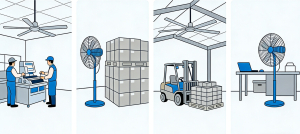
The Real Price of a Fan: Upfront Cost vs. Lifetime Value
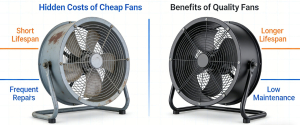
Every industrial fan has two price tags. The first is the one you see at checkout. The second is the total cost of ownership (TCO) – purchase price plus energy, maintenance, repairs, and downtime over the fan’s life.
A cheap fan might cost $150. But if it consumes 30% more electricity, needs new bearings every six months, and fails completely after two years, its TCO quickly surpasses that of a quality fan costing $450 that runs efficiently for a decade with minimal maintenance.
The Manufacturer’s Perspective: We build our fans with heavier gauge steel, better motors, and genuine ball bearings because we know that industrial environments punish shortcuts. Our customers tell us their first quality fan often outlasts three or four cheap replacements.
How Cheap Fans Waste Your Energy Budget
The motor is the heart of any fan, and motor efficiency varies dramatically. Many low-cost fans use “economy” motors that are essentially rewound or low-grade units. These motors run hotter, draw more amperage for the same airflow, and have poor power factor.
Where the waste happens:
– Inefficient blade design: Cheap fans use simple stamped blades that create turbulence and noise, moving less air per watt.
– Poor balance: Vibration means energy is being converted into shaking instead of airflow.
– Undersized motors: To hit a low price point, some fans use motors that run at maximum rated power continuously, which drastically shortens life and increases heat losses.
The quality solution: Our fans use premium-efficiency, industrial-duty motors with precision-balanced, aerodynamically designed blades. You get higher CFM per watt – lower utility bills from day one.
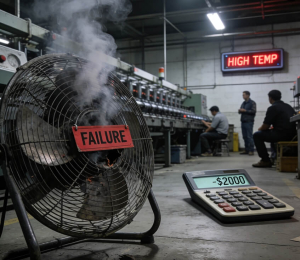
The Downtime Trap: When a $200 Fan Costs You $2,000 in Lost Production
Industrial fans rarely fail at a convenient time. A broken exhaust fan in the middle of a summer heatwave means workers stop, productivity plummets, and you are scrambling for an emergency replacement.
Common failure points on cheap fans:
- Sleeve bearings (instead of ball bearings) that dry out and seize.
- Thermal overload from undersized motors – the fan shuts itself off to prevent fire, leaving you with no airflow.
- Cracked housings from thin metal that flexes and fatigues.
- Broken blades from brittle plastic or unbalanced aluminum.
Our approach: Every fan we manufacture uses permanently lubricated, sealed ball bearings, a motor sized with a 20-30% safety margin, and a welded steel housing that does not flex. We design for continuous duty, not occasional use.
Sizing Mistakes: Why Bigger Isn’t Always Better (But Undersized Is Always Wrong)
Two common sizing errors cost facility owners money:
Error 1: Buying one giant fan for a large space
A single oversized fan creates a narrow jet of air that only affects a small area, leaving the rest of the space stagnant. Multiple smaller fans placed strategically provide far more uniform ventilation.
Error 2: Undersizing “just to save money”
A fan that is too small will run at maximum speed constantly, wearing out quickly and still failing to achieve the required air changes per hour. This is the most expensive mistake because you pay for a fan and suffer the consequences of poor ventilation.
The right way: Calculate required CFM first, then select a fan (or multiple fans) that meet or slightly exceed that number.
– Measure length × width × average height = cubic feet of space.
– Determine needed air changes per hour (4-6 for warehouses, 6-10 for shops, 8-12 for hot or fume-heavy areas).
– Required CFM = (cubic feet × ACH) ÷ 60.
– Then choose axial fans for open spaces or centrifugal fans for ducted systems.
Five Non-Negotiable Features of a Cost-Effective Industrial Fan
When you are comparing fans, do not be distracted by fancy paint or marketing claims. Look for these five engineering fundamentals:
- Totally Enclosed Fan-Cooled (TEFC) Motor: This prevents dust, moisture, and debris from entering the motor windings. A TEFC motor on a quality fan will outlast three open-drip-proof motors in a dusty warehouse.
- Permanently Lubricated Ball Bearings: Not sleeve bearings. Ball bearings handle misalignment better, run cooler, and last 5-10 times longer.
- Welded Steel Construction: Riveted or spot-welded housings come apart under vibration. Full-penetration welds create a single, rigid structure.
- Dynamic Balancing: Every impeller and blade set should be balanced at the factory. You can feel the difference – a balanced fan runs smoothly; an unbalanced one vibrates and wears out bearings rapidly.
- Proper Guarding: OSHA requires finger-safe guards. Cheap fans sometimes use wider mesh to save metal. Our guards meet or exceed OSHA standards.
Simple Payback Calculation for Your Facility
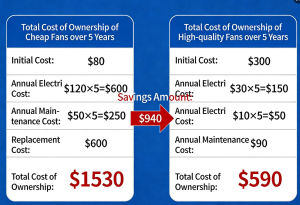
Let us compare a cheap fan versus one of our quality fans over five years.
| Cost Factor | Cheap Fan | Our Quality Fan |
|---|---|---|
| Purchase Price | $150 | $450 |
| Energy per Year (estimated) | $180 | $120 |
| Repairs & Bearings (5 yrs) | $200 | $20 (cleaning only) |
| Downtime Cost (one failure) | $1,000 (lost production) | $0 |
| Total 5-Year Cost | $1,530 | $590 |
The quality fan saves nearly $1,000 over five years and provides reliable airflow the entire time.
Conclusion: Invest in Air, Invest in Performance
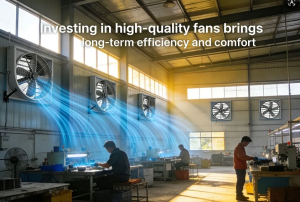
Industrial ventilation is not a place to cut corners. The cheapest fan on the market will cost you more in energy, repairs, and lost productivity than a properly engineered fan from a real manufacturer.
You need air moving consistently, quietly, and efficiently – day after day, shift after shift. That requires a fan built with industrial-grade components, not retail-grade compromises.
When you buy from our factory, you are not paying for a brand name. You are paying for thicker steel, better bearings, honest specifications, and a product designed to deliver the lowest total cost of ownership.
Stop replacing cheap fans. Start investing in lasting performance.
[Browse Our Heavy-Duty Axial & Centrifugal Fans] – Every model includes TEFC motors, ball bearings, and welded steel construction. Contact our team for a free sizing recommendation and a quote that includes true lifetime value, not just a low upfront price.


Leave a Reply
Want to join the discussion?Feel free to contribute!