

How to Choose an Industrial Fan That Actually Works for Your Space?
Selecting an industrial fan might seem straightforward, but the difference between a fan that simply moves air and one that solves your problem comes down to precise, expert-level planning. A mismatched fan can lead to wasted energy, persistent safety hazards, and frustrated workers.

As industry specialists, we’re asked daily: “Why isn’t my current ventilation working?” or “What fan do I actually need?” This guide distills our frontline expertise into a clear, step-by-step framework to help you cut through the noise and select a fan system that delivers measurable results for safety, efficiency, and compliance.
Step 1: Diagnose Your Core Challenge – What Problem Are You Solving?
Don’t start with a product; start with the problem. An effective choice hinges on correctly identifying your primary need:
• Heat Mitigation: Is worker comfort and preventing heat stress the main goal? This requires high-volume air movement over large areas.
• Contaminant Removal: Are you dealing with dust, welding fumes, chemical vapors, or mist? This demands targeted airflow and often integration with exhaust systems.
• Moisture & Humidity Control: Is condensation, mold, or corrosion an issue? This requires consistent air exchange and destratification.
• General Air Stagnation: Is the air simply dead, causing odors and discomfort? This focuses on basic circulation and fresh air introduction.
Expert Insight: Often, facilities face a combination. A warehouse may need heat relief (primary) and dust control (secondary). Prioritizing dictates the primary fan type, while secondary needs inform placement and supplementary units.
Step 2: Map Your Space – It’s More Than Square Footage
The geometry of your space is the most critical factor. Measure, but also analyze.
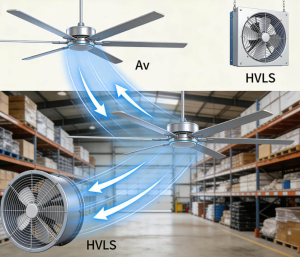
• Ceiling Height: This is the deciding factor. Spaces with ceilings over 15 feet are prime candidates for High Volume, Low Speed (HVLS) fans, which push air down to the floor effectively. Lower ceilings require axial or centrifugal fans mounted on walls, columns, or ducts.
• Obstructions: Dense machinery, tall storage racks, and partitions disrupt airflow. Your layout may necessitate multiple smaller fans rather than one large unit.
• Air Source & Exit Path: Ventilation is about creating a path. Identify where fresh air enters and where you want contaminated or hot air to exit. Fans should facilitate this flow, not fight against it.
Step 3: Calculate Your Airflow Requirements (The Numbers Matter)
Guessing on size is the costliest mistake. Use this simplified expert methodology:
1. Determine Air Changes Per Hour (ACH): This is how many times the entire air volume in a space should be replaced.
o General Ventilation: 4-6 ACH
o Moderate Heat/Dust: 6-12 ACH
o Heavy Fumes/Heat: 12-30+ ACH (requires engineered system)
2. Calculate Room Volume: Length x Width x Average Ceiling Height.
3. Calculate Required CFM (Cubic Feet per Minute): (Room Volume x ACH) / 60.
Example: A 100’ x 80’ warehouse with a 20’ ceiling needs moderate heat relief (8 ACH).
• Volume = 100 x 80 x 20 = 160,000 cubic feet.
• Required CFM = (160,000 x 8) / 60 = ~21,333 CFM.
• This could be met by two large HVLS fans or a series of smaller high-speed fans.
Step 4: Match the Fan Type to Your Technical Specs
With your problem, space map, and CFM requirement in hand, you can now navigate the product landscape intelligently.
Fan Type Best For This Problem Ideal Space Profile Key Selection Tip
HVLS Fans Heat stress, destratification, gentle drying High ceilings (>15ft), large open footprints Focus on airfoil design and motor efficiency, not just diameter.
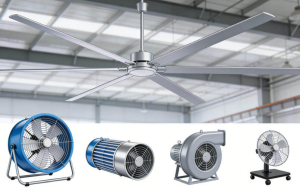
Axial Fans General ventilation, spot cooling, low-pressure exhaust Low/medium ceilings, open areas or ducted ends Match blade pitch and motor HP to your static pressure needs.
Centrifugal Fans/Blowers Removing dust/fumes, pushing air through ducts/filters Ducted systems, high static pressure applications Study the fan curve to ensure it delivers needed CFM at your system’s pressure.
Portable/Wall-Mounted Targeted cooling, temporary needs, supplementing main system Spot locations, flexible layouts, lower budgets Ensure robust construction and safety grilles for industrial use.

Step 5: Prioritize Safety & Compliance from Day One
A “working” fan isn’t just about airflow; it’s about safe operation.
• Electrical & Construction: For wet/damp environments, specify corrosion-resistant materials and appropriate ingress protection (IP) ratings. In hazardous locations (flammable vapors, dust), explosion-proof (EX) certified fans are non-negotiable.
• Physical Safety: Ensure all moving parts are guarded. Heavy-duty grilles and fully enclosed motors are standard for industrial duty.
• Noise Levels: Check the decibel (dBA) rating. A fan that’s too loud will be turned off by workers, defeating its purpose.
Expert Insight: Proactively document how your fan selection meets relevant OSHA ventilation standards (29 CFR 1910.94, 1910.107) or industry-specific codes. This turns a purchase into a compliance asset.
Step 6: Plan for Performance & ROI – The Long Game
The right fan is an investment that pays back.
• Energy Efficiency: Look for fans with high-efficiency motors (e.g., IE3, IE4) and aerodynamic designs. An efficient HVLS fan can often replace dozens of inefficient high-speed fans, cutting energy costs by 30% or more.
• Durability & Warranty: Industrial environments are punishing. Seek out robust construction (e.g., aircraft-grade aluminum, powder-coated steel), premium bearings, and a comprehensive warranty. The cheapest fan often has the highest lifetime cost.
• Ease of Maintenance: Ask about bearing service intervals, blade cleaning access, and local service support. A fan that’s easy to maintain stays online longer.
Conclusion: Your Blueprint for Success
Choosing an industrial fan that truly works is a systematic process: Diagnose your specific challenge, analyze your unique space, calculate the hard requirements, match the precise technology, and never compromise on safety. Skipping these steps leads to underperformance and wasted capital.
You don’t have to be the expert alone. This framework empowers you to ask the right questions and evaluate options clearly.
Ready to Validate Your Plan with an Expert?
Contact our engineering support team today for a complimentary, no-obligation Airflow Assessment. Share your facility details and challenges, and we’ll provide a customized fan recommendation and performance analysis tailored to make your space safer, more comfortable, and more efficient.


Leave a Reply
Want to join the discussion?Feel free to contribute!